- All
- Product Name
- Product Keyword
- Product Model
- Product Summary
- Product Description
- Multi Field Search


Views: 0 Author: Site Editor Publish Time: 2025-11-01 Origin: Site


When it comes to building a strong and stable core, two exercises dominate the conversation — the plank and the AB wheel rollout. Both are simple yet powerful tools in core training. While the plank has long been the gold standard for improving core endurance and posture, the AB wheel is gaining popularity for delivering deeper engagement and faster muscle definition.
But fitness enthusiasts often ask: Is an AB wheel better than a plank?
The answer depends on your goals — whether you’re looking for endurance, power, or sculpted abs. In this article, we’ll explore how the AB wheel works, compare it directly to planks, and determine which one deserves a place in your fitness routine.
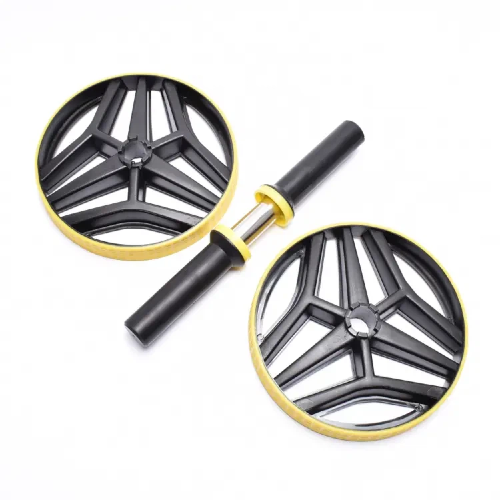
An AB wheel, also known as an ab roller, is a compact piece of fitness equipment featuring a central wheel with handles on each side. It may look simple, but it delivers a powerful workout by targeting multiple muscle groups at once.
When you roll the wheel forward and backward, your core, shoulders, arms, glutes, and back all engage to stabilize your body.
The movement of an AB wheel rollout involves both eccentric (lengthening) and concentric (shortening) muscle contractions. As you roll forward, your abdominal muscles lengthen under tension to control the descent. When you roll back, they contract forcefully to return you to the starting position.
This dynamic range of motion makes the AB wheel one of the most effective tools for strengthening and sculpting the entire midsection — far beyond what static exercises like planks can achieve.
Rectus Abdominis – The “six-pack” muscle responsible for trunk flexion.
Transverse Abdominis – Deep core stabilizer that tightens the waistline.
Obliques – Side abs that assist in rotation and stabilization.
Hip Flexors – Help control body position during rollouts.
Shoulders and Back – Maintain stability and prevent collapse during movement.
With proper technique, the AB wheel effectively strengthens not only the visible abs but also the deep stabilizing muscles crucial for posture and injury prevention.
The plank is one of the most recognizable bodyweight exercises in the world. Unlike the AB wheel, which is dynamic, the plank is an isometric exercise, meaning you hold a static position without movement. You support your body on your forearms and toes while keeping your body in a straight line from head to heels.
Core muscles: Rectus abdominis and transverse abdominis.
Shoulders: Provide upper-body stability.
Glutes and legs: Maintain hip alignment.
Lower back: Supports the spine and prevents sagging.
Improves Core Endurance – Strengthens muscles for longer-duration stability.
Enhances Posture – Builds foundational support for daily movement.
Protects the Lower Back – Stabilizes spine alignment.
Suitable for Beginners – Low-impact and accessible for all fitness levels.
While the plank doesn’t involve movement, it builds essential endurance that supports more advanced exercises like AB wheel rollouts.
The AB wheel and plank share the same goal — building core strength — but they achieve it in very different ways. The following table highlights their main differences:
Criteria | Plank | AB Wheel |
Type of Exercise | Static hold (isometric) | Dynamic rolling (eccentric & concentric) |
Primary Focus | Core endurance | Core strength and muscle development |
Muscle Activation | Moderate, sustained tension | High-intensity, full-range activation |
Difficulty Level | Beginner to intermediate | Intermediate to advanced |
Calorie Burn | Moderate | Higher due to movement and effort |
Joint Involvement | Low impact on joints | Engages shoulders, wrists, and hips |
Range of Motion | Limited | Extended and variable |
Progression Potential | Limited after mastering hold | High – can add resistance, variations |
Best For | Stability, posture, endurance | Strength, muscle tone, athletic performance |
Both exercises have distinct strengths. The plank builds a solid foundation of stability and endurance, while the AB wheel provides advanced core conditioning and total-body strength. If your goal is to challenge your muscles and build visible abs faster, the AB wheel may be the better choice.
When you use an AB wheel, you extend your body far beyond the range of a static plank. This longer motion creates deeper muscle activation, stretching and contracting the abs through a full range. That’s why AB wheel rollouts feel significantly harder — they involve more movement, more control, and more energy.
Unlike a plank that requires you to hold tension, the AB wheel requires continuous motion. Every inch of the rollout engages multiple muscle groups to maintain stability. As a result, you build both strength and muscular endurance simultaneously.
An AB wheel workout isn’t just about your abs. It challenges your entire kinetic chain — shoulders, back, hips, and even glutes. The synchronized effort improves balance, posture, and athletic coordination.
Because the AB wheel involves controlled movement and a larger range of motion, your body burns more calories per set compared to static planks. It’s not only a core exercise but also a fat-burning movement.
While the AB wheel is powerful, it’s not suitable for everyone right away. There are scenarios where the plank is the smarter option:
If you’re new to fitness, planks are the perfect way to build foundational core stability. They prepare your muscles and joints for more advanced exercises like the AB wheel rollout.
Those with shoulder, wrist, or lower back issues should start with planks. The static nature of planks minimizes movement stress and reduces injury risk.
Planks reinforce proper body alignment — shoulders back, spine neutral, core engaged. They’re excellent for improving posture, especially for people with desk jobs.
If your goal is to hold tension for longer periods, planks excel at building endurance. You can progress by adding time instead of complexity.
In summary, planks are foundational, while AB wheels are progression tools. Both have their place in a well-rounded routine.
Start with Planks:
Build core awareness, stability, and alignment.
Transition to AB Wheel Rollouts:
Once stability is established, begin with short rollouts and progress deeper.
Alternate Between the Two:
Combine static and dynamic work for maximum effectiveness.
Exercise | Sets | Duration/Reps | Focus |
Forearm Plank | 3 | 45–60 sec hold | Core endurance |
Side Plank | 3 (each side) | 30 sec | Oblique stability |
AB Wheel Rollout | 3 | 8–12 reps | Dynamic strength |
Kneeling AB Wheel | 2 | 10 reps | Beginner variation |
By combining both exercises, you create a balance of endurance, strength, and stability — all essential for a powerful, defined core.
Start with a kneeling rollout instead of a full rollout. This reduces pressure on the lower back while still targeting the abs effectively.
Keep your abs tight throughout the motion. Never let your lower back arch — it should remain flat to prevent injury.
Avoid rushing. Roll out slowly, pause at the end, and then return under full control. Fast movements reduce effectiveness and increase risk.
Always use a mat or padded floor to protect your knees during rollouts.
Inhale as you roll forward and exhale as you pull back. Proper breathing helps maintain rhythm and tension.
Select one with:
Non-slip handles for firm grip
Smooth wheel rotation for stable rolling
Durable construction for long-term use
A well-built AB wheel enhances your comfort, control, and safety during training.
Arching the Lower Back:
This transfers stress away from the abs and into the spine. Always maintain a flat back.
Rolling Too Far Too Soon:
Beginners often overextend. Start small and gradually increase depth as strength improves.
Neglecting Warm-Up:
Tight shoulders or hips can affect performance. Warm up with shoulder rolls and hip stretches.
Holding Breath:
Controlled breathing is essential for oxygen flow and core stability.
Ignoring Progression:
Add reps or range slowly. Consistency builds strength more safely than rapid advancement.
The AB wheel and the plank are not rivals — they’re allies in core development. However, when it comes to muscle activation, strength building, and calorie burn, the AB wheel clearly has the advantage.
Let’s break down why:
Higher Muscle Engagement: Activates more muscle groups at once.
Dynamic Strength Gains: Builds explosive and functional power.
Better Range of Motion: Works both abs and stabilizers in full stretch.
Progressive Overload: Can easily be made harder with resistance bands or advanced angles.
The plank, on the other hand, remains superior for beginners, posture correction, and maintaining core endurance. In short, if you’re aiming for visible definition and stronger performance, the AB wheel offers faster and more comprehensive results.
So, is an AB wheel better than a plank?
Technically, yes — for strength, mobility, and visible abdominal development. The AB wheel introduces movement, intensity, and complexity that push your core to its limits. However, that doesn’t make the plank obsolete. Instead, it lays the groundwork that makes AB wheel rollouts safer and more effective.
Whether you’re just beginning your fitness journey or pushing toward advanced performance, the smartest approach is combining both exercises. Planks teach you control; AB wheels teach you power. Together, they create the foundation for a strong, sculpted, and functional core.
For athletes and home fitness enthusiasts alike, investing in a high-quality AB wheel can transform your workouts — offering deeper activation, better stability, and long-term strength gains.
If you’re looking for durable, ergonomic, and high-performance AB wheels, Suzhou AiFlex Sports Co., Ltd. provides professional-grade fitness solutions designed for all levels. Their expertly engineered designs ensure safety, comfort, and maximum results.
Enhance your training today — take your core workouts to the next level with an AB wheel that challenges, strengthens, and reshapes your body from the inside out.

WeChat / WhatsApp: +86-18915709399
Skype: lisa.sunnylove


